
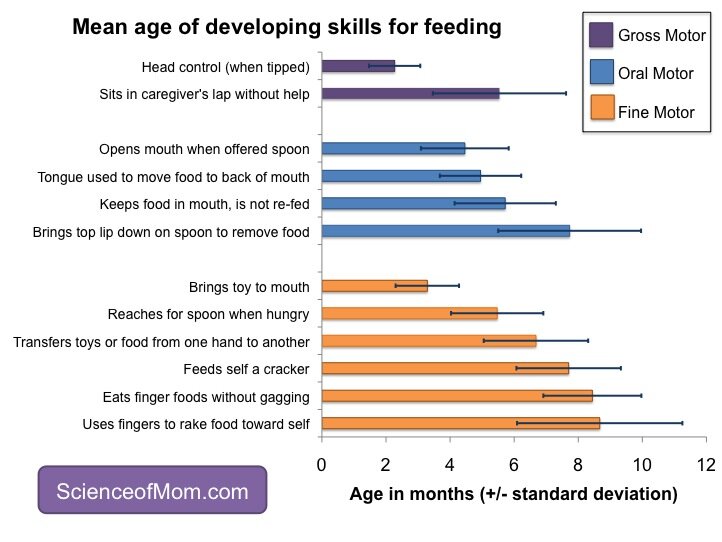
Here is an excerpt from a wonderful website, Amy’s Speech Language Therapy. Please click the link to see the progression laid fully. https://www.amyspeechlanguagetherapy.com/oral-motor.html
“Oral - motor functioning is the area of assessment which looks at normal and abnormal patterns of the lips, tongue, jaw, cheeks, hard palate and soft palate for eating, drinking, facial expression and speech to determine which functional skills a client has to build on, and which abnormal patterns need to be inhibited or for which compensation is needed. Structure (lip, tongue, jaw, cheek) affects oral motor control. Recognition of the patterns is essential to adequately attain baseline the individual's current skills, so that an appropriate plan of intervention can be developed. That plan will include mealtime interventions (positioning, handling techniques, adaptive equipment, etc.), as well as oral motor interventions to enhance control of the lips, cheeks, jaw and tongue.
Oral-motor patterns must be directly observed. It's extremely important to do a thorough oral - peripheral examination on clients of all ages. The individual presents many different patterns at once with varying degrees of severity and skill, making identification of baseline oral motor skills challenging for the therapist. Different patterns may be observed with different food types and in response to different types of stimuli. For example, a client may show good control and normal patterns with denser pureed foods, but then have great difficulty controlling fluids, showing abnormal patterns such as jaw and tongue retraction, and incoordination of suck/swallow/breathing, resulting in coughing and neck hyperextension. Be certain to assess oral-motor patterns by presenting a variety of food densities, such as thick liquids, thin liquids, semi-solids, crunchy and chewy solids (may be wrapped in thin fabric for safety) and observing the oral-motor patterns seen with each item.”